HER Lab Returns: Empowering Female Entrepreneurship in Kenya
Following a successful 2023 pilot, the Charles D. Close School of Entrepreneurship once again collaborated with Global Give Back Circle to economically empower rural young women in Kenya through the HER Lab program. Entrepreneurship can be a powerful tool to uplift and reshape communities, yet the regions where it is most impactful often face the highest barriers to entry. Entrepreneurs in these regions must overcome a “triple disadvantage” of systemic financial exclusion, restrictive gender norms such as early marriage and domestic labour that limit their agency, and a lack of access to the formal professional networks required to turn a skill into a sustainable enterprise.
Now in its 13th year, the HER Lab model is being scaled through the Economic Empowerment 4 HER program in partnership with Mastercard Foundation. This 12-month workforce-readiness initiative expands financial inclusion for young women in Arid and Semi-Arid Lands (ASAL) communities, equipping them with the skills, confidence, and real-world experience needed to transition into dignified and fulfilling work. HER Lab West Pokot is implemented by Perur Rays of Hope, a grass-roots organization with deep ties to the local community.
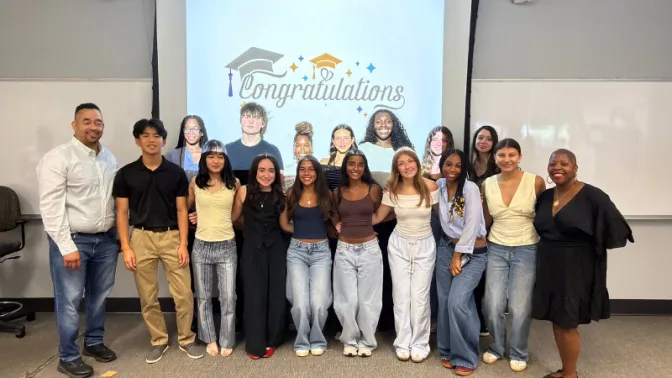
During this year’s 13-week program, two Drexel representatives (one student and one alumna) delivered a curriculum designed to build entrepreneurial thinking and practical business pitching skills. Guiding them was returning program architect and Associate Teaching Professor of Entrepreneurship Ozlem Gonul, PhD, with additional support from the team on the ground.
By linking training on how best to present their business cases with local enterprise development, HER Lab positions the young women to lift their communities as they rise. In its second year, the program’s size, and therefore its impact, doubled, from 50 participants in the 2023 pilot to 100 participants in the 2026 cohort.
Two Instructors, One Shared Purpose
For third-year economics major Chloe Mshana, the program hit close to home.
“My family’s from Uganda and Tanzania, and the program is based in Kenya, so it was intriguing to me just to have that contact with people from a community similar to mine,” she says. “Knowing that I’m able to give back in this way is really special to me.”
Mshana views entrepreneurship as a “culmination of different disciplines” and pulls experience from her diverse academic path, including a stint as a global studies major.
She was joined by Lasya Tarini, BA entrepreneurship and innovation ’25. As an instructor at HER Lab, Tarini drew from her work in community partnerships, event production, and the local startup ecosystem.
It has really made me think about my communication. We’ve had a bit of a learning curve with being more concise and adaptable. Since I started the program, I have become more self-aware in how I communicate and more confident in presenting ideas.
A Tailored Curriculum for Empowerment
Mshana and Tarini alternated teaching weeks, focusing on social entrepreneurship aspects and on pitching and presentation skills, respectively. Each leveraged their strengths and diverse perspectives while ensuring the material remained accessible for non-native English speakers.
Each week, the HER Lab participants engaged in live virtual teaching sessions built around dynamic presentations and hands-on assignments to bring their learning to life. Following the “Drexel Blueprint,” the lessons were modeled after entrepreneurship courses at the Close School but redesigned for cultural relevance.
Beyond essential pitching and public speaking skills, the curriculum emphasized the Business Model Canvas (BMC). This strategic, one-page framework allows participants to map how a venture creates and delivers value, providing a critical foundation for building businesses from the ground up.
Circular Innovation: Beyond the ‘Buy-New’ Economy
The program also integrated Circular Economy principles, a “repair-based” approach to sustainability. This model focuses on extending the lifecycle of existing goods rather than the consumption of new resources, fostering both community resilience and environmental consciousness.
The exchange was far from one-sided. While the Kenyan participants mastered Business Model Canvas, the Drexel instructors gained invaluable cultural intelligence, learning to navigate different market infrastructures, communication styles, and resource constraints. The classes ran from October through December 2025, paused for local exams and holidays, then resumed in January through February 2026 with a focus on pitch preparations. The program culminated in a final pitch competition in April 2026, where the participants presented their business ideas to a panel.
The Business Pitch: Turning Theory into Reality
After weeks of learning, mentoring and hands-on assignments, on April 1, the HER Lab participants presented their business ideas. Chloe and Lasya took their seats in West Pokot as judges, ready to witness six final teams pitch their businesses. The room was filled with excitement as Cyber Cafe, Kitale Digital Hub, Planet Cyber, Stitches by Alkebulan, Skyline Stay and Tamkal Shop stepped forward, each presenting business ideas developed over the course of the program. The judges assessed the teams based on presentation quality, clarity of the business model, confidence, innovativeness, and the practicality of their ideas in the real market.
Stitches by Alkebulan captured the spotlight, winning the Best Overall award. They stood out by bringing a tangible product: a beautifully stitched dress. Their presentation guided the audience through the creative journey, from fabric selection to tailoring and finishing touches, demonstrating both attention to detail and business insight.
“What impressed us most was their ability to turn an idea into a product that could immediately enter the market,“ Mshana says. “They showed both vision and execution.”
Vallery Atieno, a Fashion and Design participant and the team leader of Stitches by Alkebulan, reflected on her journey, saying,
When I first joined the entrepreneurship class, I never imagined I could run a business. I thought it was something for other people, not me. But as we worked through the program, developed our idea, and created this dress, my perspective completely changed. Seeing our product come to life and realizing it could be a viable business has given me confidence I never had before.
The Best Pitch award went to Skyline Stay, a food business serving travelers in West Pokot. Their concept focused on providing convenient, reliable food options for people on the move. The judges highlighted the clarity of their presentation and the team’s practical approach to customer interaction and pricing. Each member spoke confidently, demonstrating a strong grasp of their idea and how to communicate it clearly.
The Most Innovative award went to Tamkal Shop. The team ventured into sectors where women are traditionally underrepresented as a women-owned electrical installation and plumbing business. As participants at HER Lab taking electrical installation and plumbing courses, they leveraged their technical skills to create a business idea that challenged norms while meeting a real community need. Lasya commented, “This team showed boldness and creativity, combining technical knowledge with a fresh perspective on business opportunities.”
Across the competition, the participants underwent a striking transformation. They demonstrated increasing confidence and creativity, progressing from having no initial concepts to developing fully structured, market-ready ideas. The business pitch is part of HER Lab’s impact, showing how practical skills, mentorship, and hands-on learning translate into business pathways for the young women.
“Through our partnership with Drexel University’s Close School of Entrepreneurship, we are seeing HER Lab’s young women begin to view themselves differently, not only as HER Lab participants, but as innovators, business owners, and leaders in their communities,” says Linda Latsko Lockhart, Founder and CEO of Global Give Back Circle.
The goal of HER Lab is to create pathways to dignified and fulfilling work for rural young women. Entrepreneurship is one of these pathways. We can teach them practical skills, but in today’s world, they need an edge to break through. Learning how to pitch your business ideas with confidence and get financial backing does not come naturally. This partnership gives them the edge, and it is something they can pass on to others who have dreams of running their own business.
Expanding the Vision, Amplifying the Impact
The success of this second Drexel Class at HER Lab is a testament to the power of community-rooted, female-focused entrepreneurship education. This phase has laid the groundwork for a three-year expansion with Global Give Back Circle, with plans to grow the HER Lab program to five locations across the region.
For those who lived it, the experience left a mark that will last well beyond six weeks. “It has really been a great experience and one that’s been very collaborative and insightful throughout,” Mshana says.
“It can be a little intimidating to get in front of a crowd of people and say, ’this is my idea,’” she adds. “Seeing the participants’ confidence grow has been really exciting. At the end of the program, the young women were speaking with clarity and conviction.”