
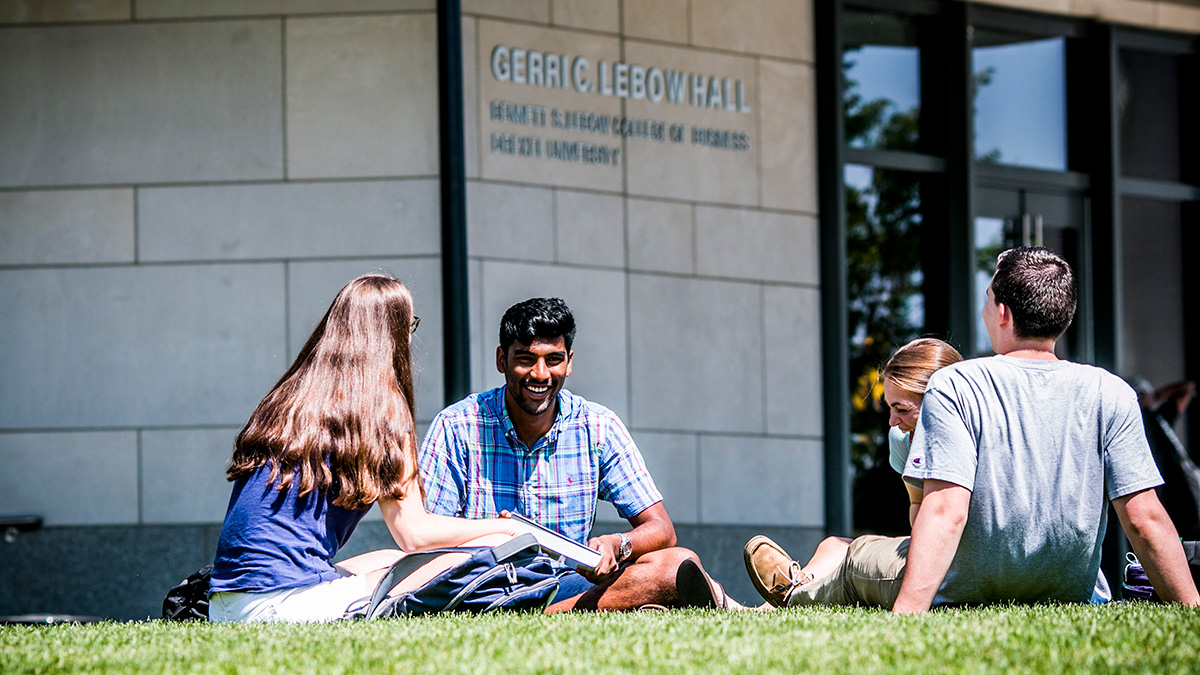



Economics and Mathematics Combined Major

Drexel University’s STEM-designated Bachelor of Arts in Economics and Mathematics is intended for students with strong interests in economics, applied mathematics and quantitative analysis. Housed in the School of Economics at the LeBow College of Business, the program combines economic theory with rigorous mathematical training, providing you with the tools to model complex problems and evaluate trade-offs. In addition to economics coursework, you’ll complete extensive study in mathematics, statistics and quantitative methods.

Why Study Economics and Mathematics at Drexel LeBow?

Understanding today’s economy requires both economic insight and quantitative expertise. At Drexel LeBow, you’ll develop the analytical mindset and mathematical foundation to study complex economic systems, evaluate real-world challenges and apply rigorous reasoning in a variety of professional settings. Through Drexel’s experiential learning model, you’ll graduate with the experience and problem-solving skills employers and graduate programs value.

Drexel LeBow’s BS in Economics and Mathematics:

  • Combines economic theory with rigorous mathematical training to prepare you for quantitative problem-solving.
  • Develops the analytical reasoning skills to formulate and analyze economic models and evaluate trade-offs.
  • Strengthens your ability to interpret data and empirical evidence using mathematical and statistical methods.
  • Prepares you for analytical careers across business, finance, consulting, government and technology, as well as graduate study in quantitative disciplines.
Faster Than Average

Projected employment growth in business and financial occupations from 2024 to 2034

U.S. Bureau of Labor Statistics

$89,364

Average starting salary

School of Economics' Class of 2024

Inside the Economics and Mathematics Curriculum

The curriculum brings together core coursework in economics and mathematics in a balanced and complementary way.

  • Economics: Students study foundational and intermediate theory, including microeconomics, macroeconomics and econometrics, with additional opportunities to engage in mathematically oriented economic analysis.
  • Mathematics: Students complete a structured sequence covering calculus, linear algebra and differential equations, along with supporting work in probability and statistics and additional electives.

Together, these course groupings prepare students to formulate and analyze economic models, understand dynamic and uncertain environments, and interpret empirical evidence with precision.

Review the Degree Requirements
View a Sample Plan of Study

Course Highlights Include
ECON 3348: Mathematical Economics

Discusses the application of mathematics in economic models, with a focus on economic applications of calculus, linear algebra, and other mathematical tools. Considers the implications of the model assumptions for the maximization of profits and utility. Stresses mathematical models and techniques useful in theoretical and applied applications to micro, macro, and financial economics. Some discussion of dynamics, expectations, and equilibrium concepts are contained in the macro portion of the course. As a required course, it supports progression in the program. Students will learn to apply key concepts, analyze real-world situations, and communicate evidence-based recommendations.

MATH 2401: Linear Algebra I

Introduction to linear algebra. Topics include: systems of linear equations, matrix algebra, determinants, vector spaces, eigenvalues and eigenvectors, orthogonality, diagonalization, applications.

MATH 2901: Matrix and Differential Systems I

A combined introuction to linear algebra and ordinary differential equations aimed at Engineering students. Linear algebra topics covered include: systems of linear equations, matrix algebra, determinants, eigenvalues and eigenvectors. Differential Equations topics covered include: linear first and second order differential equations, the simple harmonic osciallator, the phase plane, Laplace transform and linear stability analysis. Applications drawn from STEM fields are emphasized.

MATH 2801: Probability and Statistics

A Calculus based introduction to probability and statistics. Topics include axioms of probability, counting techniques, conditional probability and independence, discrete and continuous probability distributions, random variables, and joint & marginal distributions for discrete random variables.

ECON 3360: Time Series Econometrics

This course introduces the students to time series econometric models and provide them with tools for empirical analysis using time series economic and financial data, with specific emphasis on application and forecasting. This course draws upon macroeconomics and financial economics for the purpose of applying various time-series econometric tools to real world examples. The topics to be covered include AR, MA, ARMA/ARIMA models, deterministic and stochastic trends, structural breaks, vector auto regression (VAR) models, time-varying volatility, and some of recently developed tools in non-stationary time series econometrics. As an elective, it provides additional depth for interested students.

Drexel Esport Business Student on Co-op

Drexel Co-op and Experience

Through the Drexel Co-op program, students alternate classroom learning with full-time professional experience through University-approved employers. With plans of study that allow for up to three co-ops, you can gain as much as 18 months of practical experience while building professional networks, developing career clarity and applying classroom knowledge in real-world settings.

Up to 18 months of experience

Graduate with as much as 18 months of experience in the workplace

$21.19

Median co-op hourly pay

School of Economics' Class of 2024

45%

of co-op students received a full-time job offer from their co-op employer

LeBow Class of 2024

Our students have done their co-ops in a variety of organizations, both locally and around the world.

Past economics and math co-op placements include:

Goldman Sachs, Lenovo, PECO, Relationship Velocity

Beyond Co-op

Co-op is just one way to gain real-world experience at LeBow. Many students also expand their experience through consulting courses, case competitions, research projects, international residencies, industry events, alumni mentorship and other hands-on learning opportunities.

Many of these opportunities are made possible through the Dana and David Dornsife Office for Experiential Learning, where students work on real and simulated projects with industry partners. Partners have included organizations such as Unilever, the Philadelphia 76ers, Boeing, PwC, and nonprofit and governmental agencies.

Malinka Ranasinghe

The research aspects of so many of my classes really prepared me for this position with EY. I loved that it was not just theory, it was real world. You would read a paper about some real problem that is going on and then see the theory in action.

Malinka Ranasinghe ’16

Tax Staff

EY

Read more about Malinka

What Can You Do With an Economics and Mathematics Degree?

Graduates are prepared for a range of careers across the public and private sectors. The combined training supports roles in:

  • Economic analysis
  • Consulting
  • Finance
  • Risk and market analysis
  • Policy evaluation

The program also provides preparation for graduate study in economics, applied mathematics, statistics, public policy and related quantitative fields. By developing both theoretical insight and mathematical rigor, graduates are well positioned for careers that demand careful modeling, logical reasoning, and disciplined analysis of complex economic problems.

Learn more about economics career opportunities

Common Questions About the Economics and Mathematics Degree Program
What types of students are a good fit for the economics and mathematics combined major?

This program is a strong fit for students who enjoy mathematics, analytical thinking and understanding how economies and markets work. If you’re interested in solving complex problems, building mathematical models and using quantitative reasoning to study economic questions, the combined major provides the depth and rigor to support those interests.

What skills will I develop in the economics and mathematics program?

You’ll develop a combination of economic reasoning and quantitative problem-solving skills. Through coursework in economics, mathematics and statistics, you’ll learn to build and analyze economic models, evaluate trade-offs, interpret empirical evidence and approach complex problems with logical, data-informed reasoning. You’ll also have opportunities to apply these skills through Drexel Co-op and other experiential learning opportunities.

Take the Next Step

All undergraduate applications are processed through Drexel University’s central admissions portal. Have questions about applying to LeBow? Our undergraduate enrollment team is here to help.

Tuition and Financial Aid

Find the information you need to plan for your education through Drexel Central. Review tuition and fees, estimate the cost of attendance, and explore financial aid resources, including scholarships, grants, loans and payment options.

Connect with Us

Our staff is ready to help you with any questions you may have about the application process, including which program is right for you. We look forward to hearing from you.

Caitlin Brady

Director, Undergraduate Programs and Recruitment

(215) 571-3570

Gerri C. LeBow Hall 333