Beyond the Classroom: What Happens When Entrepreneurship Students Hit the Streets of New York
There is a moment — familiar to anyone who has ever left the classroom and stepped into the real world of entrepreneurship — when abstract concepts suddenly become concrete. When the frameworks, the case studies and the pitch deck templates dissolve, and what remains is something much more alive: a founder at a whiteboard talking about the company they almost lost, or an investor explaining what actually separates a promising startup from one that fades. That moment happened, again and again, during the Close School of Entrepreneurship’s spring break immersion trip to New York City.
A cohort of four Close students — ranging from their first to fourth years of study — spent three days visiting four distinct organizations across the New York startup and innovation ecosystem. The itinerary was intentional: each stop offered a different vantage point on what it means to build, fund and scale a business. The learning outcomes were immediate, personal and, by every measure, lasting.
Stop One: Newlab at the Brooklyn Navy Yard
The first afternoon took students to Newlab, a venture platform embedded within the historic Brooklyn Navy Yard. Newlab supports critical technology companies by providing not just physical workspace but prototyping labs, access to capital networks, and connections to government and industry partners. The scale of the facility — occupying a converted shipbuilding hall with sweeping views of the harbor — was itself a lesson in possibility.
For Garrett Johnson, a fourth-year student, the visit reframed something fundamental about how he had been thinking about entrepreneurship. Back in Philadelphia, the startup ecosystem can feel constrained by geography. New York, and Newlab specifically, suggested a different model.
In New York, one finds abundance instead of scarcity. The Navy Yard has ample space, including access to private waterways and airspace, that incubating companies can use to fuel innovation. — Garrett Johnson, entrepreneurship ’26
The physical reality of a place like Newlab — its resources, its density of talent and its deliberate design for collision and collaboration — made the concept of an innovation ecosystem tangible in a way that a syllabus simply cannot.

Stop Two: GarageCo Holdings, Hudson Yards
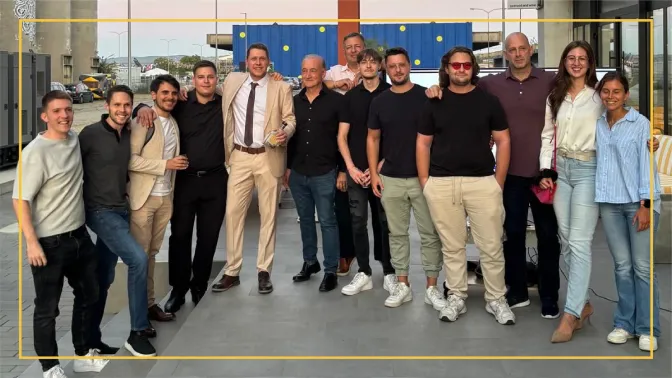
Day two began at GarageCo Holdings, a company that acquires local, family-owned garage door businesses across the country, providing capital and operational expertise while preserving the identity and legacy of each acquired company. The business model is a masterclass in a form of entrepreneurship students rarely encounter: the acquisition entrepreneurship playbook. The meeting was led by Mars Shah, BSBA ‘11, GarageCo’s founder and CEO, along with his Director of Financial Planning and Analysis and Corporate Development lead.
The room was full of Drexel energy, and the students felt it. For first-year student Sophia Lin, the conversation at GarageCo produced one of the trip’s most-quoted takeaways:
I learned that IQ may help you get through your interview, but EQ helps you succeed in your career. I also enjoyed hearing the stories from the people in that company about how they turned their ideas into successful businesses. — Sophia Lin, entrepreneurship ’29
The GarageCo visit also illustrated something students can struggle to grasp from the inside of a business school: that competitive advantage doesn’t always mean competing on price or product. Sometimes it means redefining the game entirely. As Johnson observed, GarageCo “directly connects business owners to acquisition opportunities within their network, rather than competing for market share by lowering prices.” That insight — abundance over scarcity, partnership over competition — became a throughline for the entire trip.
Stop Three: JVP Margalit, SoHo
The afternoon of day two shifted to the capital side of the ecosystem, with a visit to JVP Margalit, a venture capital firm in SoHo. Students met with Lauren Kiel, North American Head of Investor Relations, who offered a candid look at how institutional capital evaluates early-stage companies and what it actually looks like to build a portfolio from the investor’s chair.
For first-year student Namita Parekh, the cumulative effect of the visits was becoming clear. Across every room they entered, she noticed the same thing: founders and investors who had genuinely believed in what they were building, even when the path was uncertain.
What stood out to me most was the level of passion and dedication within each team. Even when these companies were just starting out, people truly believed in their vision — and that kind of energy was really motivating to witness. — Namita Parekh, entrepreneurship ’29
The venture capital context added a layer of literacy that classroom simulations rarely achieve. Understanding how a firm like JVP Margalit thinks — the portfolio thesis, the risk calculus, the relationship between founder and funder — gave students a fuller picture of the ecosystem they are preparing to enter.

Stop Four: Start 2 Group, Union Square
The final morning brought the group to Start 2 Group in Union Square, an organization that helps international startups — particularly through its flagship German Accelerator program — navigate entry into the US market. Students met with Willow Sprague, a Program Manager and former Shark Tank contestant, whose own entrepreneurial journey added a layer of authenticity and relatability to the conversation.
The theme of career exposure resonated most deeply for second-year student Sandy Nguyen, who has been building her own food business alongside her studies. For Sandy, the trip’s most important learning wasn’t a single lesson — it was the cumulative experience of seeing how many different forms a career in entrepreneurship can take:
The most impactful part of the trip for me was exposure, and specifically career exposure: being able to see the different directions and careers that people end up pursuing. How reassuring their career paths are for students who might feel lost. — Sandy Nguyen, entrepreneurship ’28
That reassurance — grounded not in platitude, but in firsthand contact with people who had navigated real uncertainty — is something a curriculum can point toward but rarely deliver directly.
What the Trip Was Really Teaching
Across four stops and three days, a set of learning outcomes emerged that were consistent across students regardless of year or background. First: the entrepreneurial ecosystem is not a metaphor. It is a physical, relational, and institutional reality — and direct exposure to it builds a kind of confidence that case studies cannot replicate. Second: EQ, network, and narrative are not soft skills. They are the operating system of every company these students visited. Third: career paths in entrepreneurship are nonlinear, diverse, and more accessible than they appear from a distance.
These are not small things. They are the outputs of a learning experience designed to close the gap between entrepreneurship as a subject and entrepreneurship as a practice — and by every account, the Close School’s New York Immersion Trip delivered.