In a New Spin on a Business Classroom Staple, LeBow Team Places Third in MikesBikes World Championship
For first-year LeBow undergraduate students, MikesBikes is a rite of passage.
Using this online platform developed by SmartSims, a New Zealand-based company, to simulate building and running a bicycle manufacturing company provides many students with their first exposure to business fundamentals — coming up with a product, pricing it, marketing it — during Foundations of Business (BUSN 102) courses.
Those introductory courses also put teams into friendly, low-stakes competition, trying to maximize their company’s profits. One team wanted to take their MikesBikes experience to the next level and earned success on a global stage.
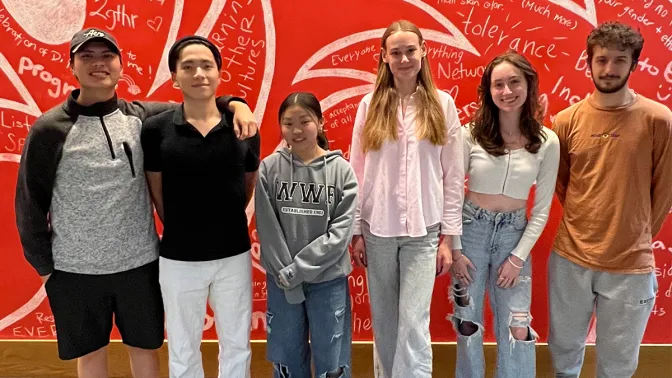
In the MikesBikes World Championship, Team FreeWheel, comprised of LeBow undergraduates Nate Ryan, BSBA finance ’29; Selena Liu, BSBA accounting and finance ’30; and Angela Phen, BSBA management information systems ’30, placed third overall.
After placing second in their class competition, Liu and her teammates felt encouraged enough by the experience to register for the World Championship.
“We really broke down our classmates’ strategies to figure out what they did to be number one,” says Liu. “After we thought back to the lessons we learned and the strategies we used, we broke down the reasons behind them and the difference they made in our final results.”
The Championship featured one notable difference from BUSN 102, though: it used MikesBikes Advanced, a newly developed version of the simulation, and the LeBow team found it more complex than the simulation, MikesBikes Introduction, they used just eight months ago.
“The Advanced version was focused more on supplier relations, hiring, idle time and the overall quality of products and defects,” Phen says. “It really made me think about how important the supply chain side of business is and how that contributes to people buying your product.”
This challenge provided Phen and her teammates with an opportunity to level up their analytical skills and overall business sense.
It made us think more as businesspeople, rather than students in a classroom, fighting to be number one. We asked, how do they operate their businesses? What are some long-term strategies we can use, rather than ones for short-term profit?
Even with a more advanced platform, the goal in the World Championship was the same as in the classroom: the team that generated the highest shareholder value was named the winner, and after the Championship’s opening round, Team Freewheel placed tenth out of 26 teams worldwide, qualifying them for the Championship finals.
Against more experienced undergraduate students, this team of first-year business students doubled down on their MikesBikes experience, thinking back to advice from their BUSN 102 instructor, clinical professor of general business Chris Finnin, EdD.
“We tried to purchase standard capacity units, or SCUs, as early in the simulation as possible,” Ryan says, allowing them to build up manufacturing capacity they’d need at a later stage.
As they grew more invested in the outcome as the competition progressed, a fun diversion during the summer after their first year at Drexel turned into something larger.
“As we went on and started learning more, we really saw our work producing results, which led us to putting in even more time and effort,” Ryan says.
“I felt so proud to be representing Drexel, especially with earning third place,” says Liu. “We were just so surprised by how far we made it, and it really shows that hard work always pays off.”
Two teams from the University of Auckland finished in first and second place ahead of the LeBow team, with other teams from the U.S. and Australia rounding out the top 10.