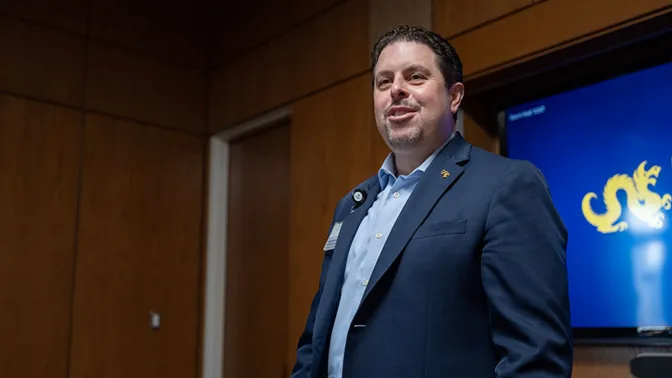
What It Takes to Lead in Health Administration
Ashley Medina already had a successful career in healthcare as a practice manager in outpatient primary care. But she wanted to take the next step into a higher-level role and knew she needed to broaden her knowledge and expertise to get there.
Today, she’s a director of quality resources at Robert Wood Johnson University Hospital at Rahway, thanks in part to earning her Master of Health Administration (MHA) at Drexel in 2026. “It really does open doors,” she says. Within healthcare, “the field of quality and safety is very niche,” and a master’s degree becomes a key separator.
Previously based in Drexel’s College of Nursing and Health Professions, the MHA program moved to the University’s LeBow College of Business in 2025 — reinforcing a distinct perspective in the program.
“Healthcare is a business,” says Kevin Mitchell, PhD, an assistant clinical professor in LeBow and the MHA program director. When students earn their MHA at a business school, “they get to look at things from the business level: finance, operations, organizational leadership. The faculty in the LeBow MHA program are leaders in healthcare, but they’re also leaders in the business world.”
Preparing for a Higher Level
The MHA can help drive career advancement for those, like Medina, who are already working in healthcare and looking to take on more responsibility.
“What we see in [professionals’] applications is that they may know what happens in their part of the organization, but in order to move to a higher level, they need to know about how systems work together,” says Kristine Mulhorn, PhD, clinical professor and head of the Department of Health Administration at LeBow.
“They need the bigger picture, and they need the management skills,” she says. Healthcare professionals come to LeBow looking to build skills in areas like finance and human resource management, as well as gain insights into how leaders drive innovation.
The MHA also gives students opportunities to put those skills into practice, including through a five-day residency. “Students participate in a consultancy project, and it allows them to apply those skills in a final project that they can take with them” and show to future employers, Mulhorn says.
Lisa Scott, MHA ’25, worked on a project focused on “bringing new equipment into the hospital to increase patient safety, patient satisfaction and employee satisfaction,” and she recalls both her presentation and the residency as “wonderful, collaborative experiences.”
Now a nurse manager at Pennsylvania Hospital, Scott says, “Through the residency, we were able to network with each other and connect with multiple guest speakers. Hearing about how these leaders have grown their careers in healthcare really convinced me I was on the right path.”
A Growing Need for Healthcare Leaders
Careers in medical and health services management are taking off, with employment projected to grow 24% between 2025 to 2035 and a median annual income of more than $123,000, according to the U.S. Bureau of Labor Statistics.
A bachelor’s degree typically isn’t enough to land many higher-level positions. “Whether it’s a supervisor role within a health system, or a directorship with financial responsibility, those jobs require a master’s degree,” Mulhorn says.
An MHA from a business school can help take healthcare professionals to the next level, and the LeBow MHA delivers a broad base of practical skills for those looking to advance. “Students learn things like healthcare marketing and healthcare innovation, and they gain an understanding of how the business of healthcare is organized,” Mulhorn says.
Unlike an MBA with a healthcare concentration, the LeBow MHA curriculum emphasizes specific healthcare competencies. For those committed to a career in healthcare leadership, Mulhorn says, “the promise of an MHA is that every course will be within a healthcare context.”
“When they finish this program, they’re prepared to get into higher-level positions in areas like operations, policy, quality improvement, technology innovation and hospital leadership,” she adds.
Making Your Next Career Move
Some students come to the MHA already having career success in areas outside of healthcare. With demand for health-related services on the rise, they are looking for a way to pivot into a fast-growing field.
Shifting from one field to another can feel daunting, “and we are going to support their transition,” Mitchell says. “We meet them where they are, map out a pathway that builds on their current experiences and connect it with their passions.”
Faculty members take a student-centered approach to helping professionals navigate career changes, while advisors help each student plan a program of study specific to their needs.
That support can also help healthcare professionals, like Medina, move into new areas of the field. She had experience in process improvement that she felt she could apply to quality and safety, and she knew a master’s degree could help open that door.
“Sometimes, a position can be open for a long period of time because the right candidate hasn’t applied or there’s not a right fit,” Medina says. A master’s degree, she’s found, “pushes you to the top of the candidate pool.”