
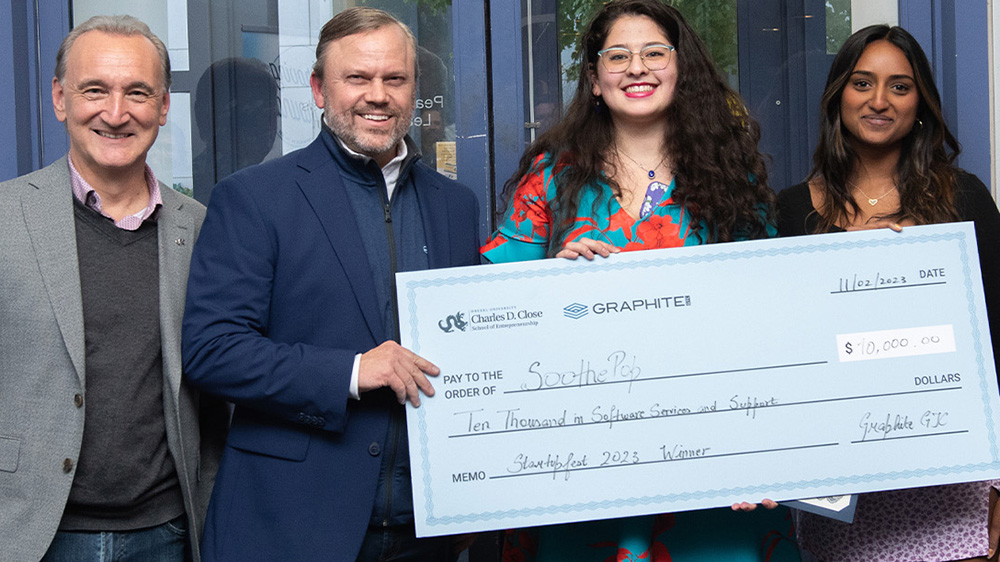

The Close School of Entrepreneurship presents Startup Fest 2025 winners with a check for $10,000.

BSBA Major in Entrepreneurship

The entrepreneurship major, housed in the Charles D. Close School of Entrepreneurship at the LeBow College of Business, prepares you to design, test, launch and scale new ventures and innovation initiatives in uncertain, fast-changing environments. Our students learn how to move from ideas to action by combining entrepreneurial judgment with disciplined analysis, evidence-based decision-making and ethical responsibility. Through applied coursework, venture-focused experiences and engagement with entrepreneurs and industry leaders, you’ll develop the skills needed to evaluate opportunities, execute ideas and drive innovation.

#2

Top Schools for Entrepreneurship Studies, Mid-Atlantic Region

The Princeton Review, 2025

$70,411

Average starting salary for LeBow BSBA graduates

Class of 2025

Why Major in Entrepreneurship at Drexel LeBow?

Entrepreneurship is about recognizing opportunities and turning ideas into action. At Drexel LeBow, you’ll learn how to transform those ideas into viable ventures and innovative solutions through hands-on learning, evidence-based decision-making and practical experience.

Evaluate Opportunities and Build Ventures

Develop the entrepreneurial, analytical and strategic skills needed to evaluate opportunities and build sustainable ventures.

Learn by Doing

Gain real world experience through venture-focused coursework, startup simulations and pitch competitions.

Access our Startup Incubator

Tap into Drexel’s entrepreneurial ecosystem, including the Baiada Institute for Entrepreneurship, where experienced entrepreneurs, investors and mentors help students develop and refine new ventures.

Turn Entrepreneurial Skills Into Action

We prepare graduates to launch new ventures or drive innovation within startups, growing companies and established organizations.

Inside the Entrepreneurship Major Curriculum

Entrepreneurship requires creativity, sound judgment and the ability to execute. The curriculum combines business fundamentals with entrepreneurial practice, preparing you to evaluate opportunities, navigate uncertainty and make evidence-based decisions throughout the venture creation process.

You’ll explore topics such as opportunity recognition, venture planning, innovation strategy and business growth while strengthening your skills in critical thinking, communication and ethical decision-making. Throughout the program, you’ll apply what you learn through hands-on projects that mirror real entrepreneurial challenges.

Visit the Drexel Course Catalog

Course Highlights Include
ENTP 2210: Leading Startups

In this course, students will explore the boundary-spanning role of the CEO in a startup or new venture and examine how the responsibilities of entrepreneurial founders evolve throughout the venture’s lifecycle. Through practical exercises and simulations, students will gain an appreciation for the opportunities and challenges faced in building a company—from transitioning an idea into execution, creating a compelling vision, navigating equity splits and securing startup funding, and working productively and harmoniously with co-founders, to building early executive and management teams, assembling a board of directors, and managing key stakeholders. The course also covers potential exit paths, including acquisition or initial public offering.

ENTP 3345: Startup Due Diligence Analysis

Students learn and work as analysts in teams to conduct real diligence on prospective early-stage venture investments. Using professional venture evaluation frameworks, they assess market opportunity, product fit, founder character, a critical but often overlooked dimension of early-stage evaluation, team capabilities, financials, risks, and potential impact. Analyst work emphasizes integrity in sourcing, thorough note-taking, and clear, evidence-based conclusions. Deliverables mirror professional practice, including diligence memos, reference checks, and investment committee presentations that prioritize clarity, evidence, and sound judgment. As an elective, it provides additional depth for interested students.

ENTP 2215: Building Entrepreneurial Teams

This course examines how startup companies leverage the power of their teams to achieve their company goals. Students will learn how entrepreneurial teams form, develop trust, manage conflict, make critical decisions, and adapt to changes. Emphasis is placed on understanding the interplay between individual differences, team processes, and organizational outcomes. The overall purpose of this course is to understand and evaluate various approaches to forming teams during the establishment of a new company. This course will compare various team formation models to determine their advantages and disadvantages as well as their effects on the expected outcomes. As a required course, it supports progression in the program.

ENTP 3340: Scaling Entrepreneurial Ventures

This course examines the challenges and opportunities of growing an entrepreneurial venture in today’s fast-changing environment. Students will explore how founders and leaders scale operations, manage talent, secure resources, and balance growth with sustainability. Topics include strategy, marketing, finance, organizational culture, risk management, and founder well-being. Students will also learn how emerging technologies and data-driven tools can support decision-making and growth. Through cases, simulations, and applied projects, students will analyze growth strategies, assess operational trade-offs, and design approaches that foster both resilience and long-term value creation.

ENTP 3385: Innovation in Established Companies

This course examines how established organizations create value and competitive advantage through innovation and entrepreneurship using internal R&D, corporate venturing, and external partnerships. Students learn to identify promising opportunities, design and run pilot projects, and build support across the organization. The course covers incremental, disruptive, and business-model innovation, as well as core new-product development activities from customer insight and prototyping through launch and commercialization. Learning is based on case studies, simulations, and in-house company projects, emphasizing practical execution and responsible risk-taking in real organizational settings.

Looking Ahead to Fall 2027

Learn how Drexel University’s Academic Transformation creates more flexibility, deeper learning and more opportunities for real-world experiences.

a student at the Close School presents her startup idea during a co-op

Drexel Co-op and Experience

Through the Drexel Co-op program, students alternate classroom learning with full-time professional experience through University-approved employers. With plans of study that allow for up to three co-ops, you can gain as much as 18 months of practical experience while building professional networks, developing career clarity and applying classroom knowledge in real-world settings.

Up to 18 months of experience

Graduate with as much as 18 months of experience in the workplace

$22.00

Median co-op hourly pay

2024–2025 Academic Year

Entrepreneurship students often pursue co-op experiences with startups, growth-stage companies and innovation teams, gaining firsthand experience with venture operations, product development and business growth.

Past co-op placements include:

Entrepreneurship co-op employers include Amazon, Campbells, go puff, Paramount and PayPal.

Beyond Co-op

Co-op is just one way to gain real-world experience at LeBow. Many students also expand their experience through consulting courses, case competitions, research projects, international residencies, industry events, alumni mentorship and other hands-on learning opportunities.

Many of these opportunities are made possible through the Dana and David Dornsife Office for Experiential Learning, where students work on real and simulated projects with industry partners. Partners have included organizations such as Unilever, the Philadelphia 76ers, Boeing, PwC, and nonprofit and governmental agencies.

The Laurence A. Baiada Institute for Entrepreneurship

The Baiada Institute is the hub of student innovation at Drexel. As part of the Charles D. Close School of Entrepreneurship, the Baiada Institute empowers students from every major to launch and grow their ventures.

With access to mentorship, funding, competitions and a vibrant entrepreneurial community, you’ll gain the tools and support you need to bring your ideas to life.

Inside the Baiada Institute.
Aquiera Halsey student photo

I felt that if I studied entrepreneurship and learned the fundamentals of business then no one would be able to take my business away from me. If it wasn’t for Drexel I wouldn’t have the confidence in such a high-stress, high reward environment.

Aquiera Halsey ’11

Manager, Oncology Quality Data & Cancer Registry

Thomas Jefferson University Hospital

Read more about Aquiera

What Can You Do With a BSBA in Entrepreneurship?

An Entrepreneurship degree prepares you to create value in many different settings, whether you’re launching your own venture, helping a startup grow or leading innovation within an established organization. Graduates develop the ability to identify opportunities, solve complex business problems and turn ideas into action across industries.

Career paths may include:

  • Founder or entrepreneur
  • Venture operator
  • Innovation manager
  • Product manager
  • Business consultant
  • Growth or business development manager

The program also provides a strong foundation for graduate study in business, entrepreneurship, innovation and related fields.

Common Questions About the Entrepreneurship Major
What types of students are a good fit for the entrepreneurship major?

The entrepreneurship major is a strong fit for students who enjoy solving problems and thinking creatively. The skills you learn will be useful whether you want to launch your own business, join a startup or work within an established organization. The program is ideal for students who are curious, adaptable and motivated to make an impact through business.

What’s the difference between the BSBA in Entrepreneurship and the BA in Entrepreneurship and Innovation?

The BSBA in Entrepreneurship is a business-focused degree that combines core business disciplines with entrepreneurial strategy, analytical decision-making, and venture creation to prepare students to launch and grow businesses or drive innovation within organizations.

In contrast, the BA in Entrepreneurship and Innovation emphasizes creativity, interdisciplinary collaboration and entrepreneurial thinking, preparing students to solve complex problems and create value across startups, corporations, nonprofits and other sectors. Both programs provide hands-on experiential learning, but the BSBA offers a broader business foundation, while the BA takes a deeper, innovation-centered approach.

Is entrepreneurship still a good major if I don’t want to start my own business?

Yes! While some students aspire to launch their own ventures, many use their entrepreneurial skills in established organizations. Entrepreneurship graduates pursue careers in product management, business development, consulting, innovation management, venture operations and other roles where they identify opportunities, solve problems and lead new initiatives. The program prepares you to think entrepreneurially whether you’re building a startup or helping an organization grow and innovate.

Take the Next Step

All undergraduate applications are processed through Drexel University’s central admissions portal. Have questions about applying to LeBow? Our undergraduate enrollment team is here to help.

Tuition and Financial Aid

Find the information you need to plan for your education through Drexel Central. Review tuition and fees, estimate the cost of attendance, and explore financial aid resources, including scholarships, grants, loans and payment options.

Connect with Us

Our staff is ready to help you with any questions you may have about the application process, including which program is right for you. We look forward to hearing from you.

Germyce Harris Williams

Assistant Director, Recruitment & Retention

(215) 571-3392

Pearlstein Building 429